
Senior Fall Prevention Starts With the Home
September 29, 2026 · Kindred Home Support
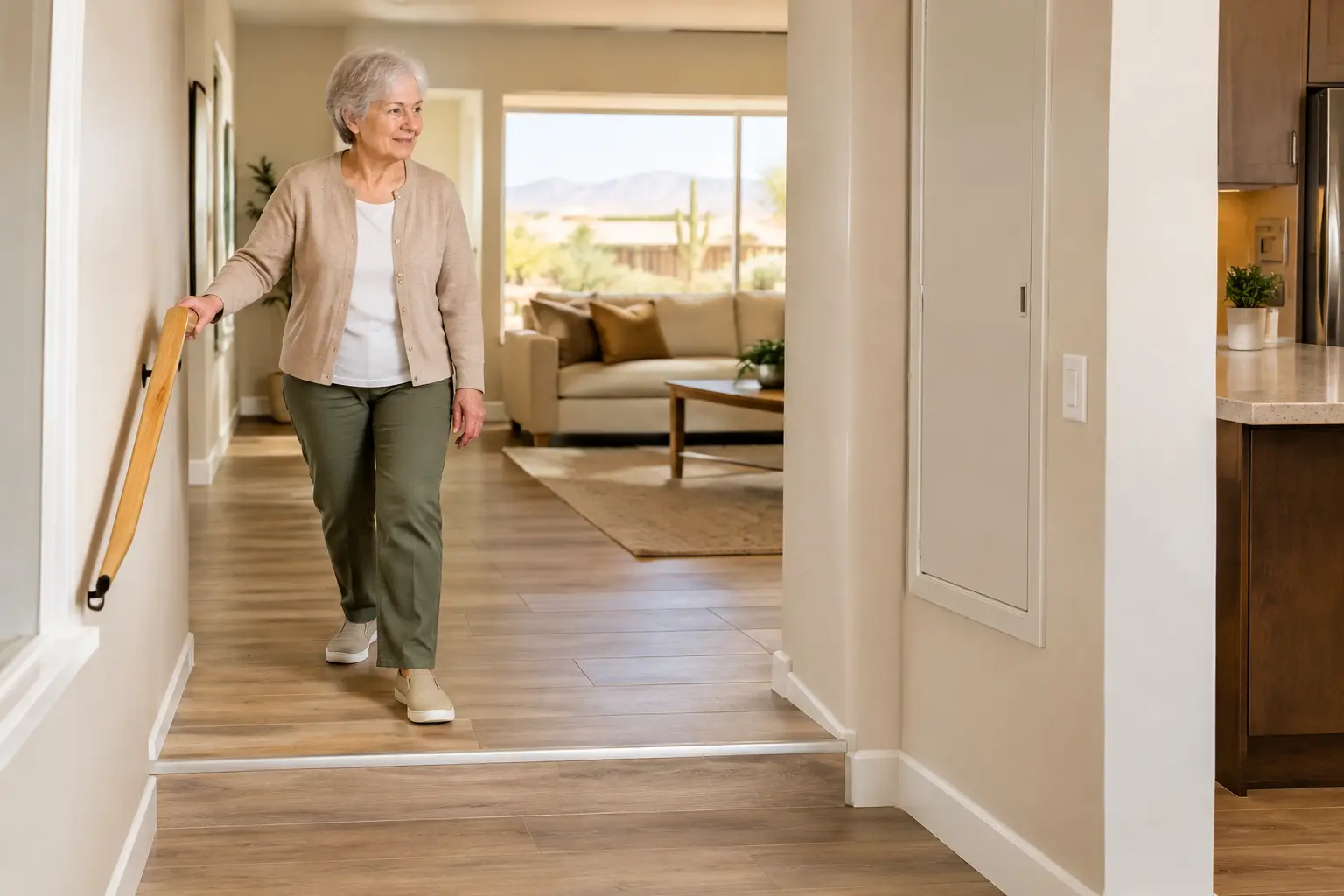
A fall often starts with something that looked too small to address: a loose rug corner, a dim hallway bulb, a phone charger stretched across a walkway, or a step that has become harder to judge at dusk. Senior fall prevention is not one product or one annual safety check. It is the steady work of keeping the home predictable, comfortable, and free from preventable disruptions.
For adults aging in place, the goal is not to make a home feel institutional. It is to preserve familiar routines while reducing the everyday conditions that can turn a normal trip to the kitchen, bathroom, mailbox, or bedroom into a risk. For families and care teams, a well-maintained home also means fewer urgent calls, fewer avoidable interruptions, and clearer confidence that small concerns are being handled.
Senior Fall Prevention Begins With Everyday Conditions
Many fall risks develop gradually. A person may begin avoiding a room because the lighting is poor, taking a shorter route through a cluttered area, or holding onto furniture because a handrail feels unsteady. These adaptations can be easy to miss, especially for family members who visit occasionally.
That is why the home itself should be treated as an active part of the support plan. Walkways, entry points, bathrooms, appliances, lighting, flooring, and daily-use devices all affect whether a person can move through the house with confidence. A home does not need to be perfect to be safer. It needs regular attention and prompt follow-through.
The most useful question is simple: Can this person move through their normal day without needing to work around a household problem? If the answer is no, the issue deserves attention before it becomes an emergency.
Pathways should support the routine, not interrupt it
The highest-traffic routes deserve the closest review. Consider the path from the bed to the bathroom, the front door to the mailbox, the kitchen to the dining area, and the living room to the thermostat or favorite chair. These are the areas people use when they are tired, carrying something, responding to a doorbell, or moving in low light.
Clear routes are not only about removing clutter. They also involve securing loose cords, moving small tables that narrow a passage, checking whether furniture has shifted, and keeping commonly used items within easy reach. A basket or decorative stool may look harmless until it becomes an obstacle during a rushed nighttime trip.
Rugs require a practical decision. Some are meaningful, attractive, or helpful for comfort, but any rug that curls, slides, or bunches creates a trip hazard. Non-slip backing may solve the problem in some cases. In others, removing the rug is the safer choice. The right answer depends on the person’s mobility, footwear, flooring, and how often that area is used.
Lighting is a safety system
Poor lighting creates more than inconvenience. It makes thresholds, changes in floor surface, steps, and objects on the ground harder to see. In Henderson and Boulder City, bright daytime sun can also create glare near windows and exterior doors, making the shift from indoor to outdoor light more difficult.
Check that bulbs are working in hallways, stairways, bathrooms, garages, closets, and entrances. Night-lights can make a familiar route easier to follow without requiring a person to switch on overhead lighting. Exterior lighting matters too, particularly at driveways, gates, porch steps, and the route from a parked car to the front door.
Lighting should be easy to control. If a switch is inconveniently located, a person may walk through a dark room rather than turn on the light. A practical setup puts light where it is needed and makes it simple to use.
Bathrooms and entry points need closer attention
Bathrooms combine hard surfaces, water, limited space, and frequent transitions from sitting to standing. A non-slip bath mat, stable towel bar alternatives where support is needed, clear access to toiletries, and a dry floor can make a meaningful difference. Grab bars or seating may be appropriate, but installation and placement should be determined thoughtfully, especially when a person’s mobility or health needs are changing.
At entrances, inspect steps, handrails, thresholds, doormats, and door hardware. A handrail that wobbles, a screen door that sticks, or a mat that shifts can cause hesitation at exactly the wrong moment. Minor repairs are often straightforward, but delaying them allows a small mechanical issue to become part of someone’s daily risk.
The Household Details That Are Easy to Postpone
Fall prevention is often discussed in terms of major home modifications. Those can be valuable, but routine maintenance matters just as much. A safe home is built through consistent follow-through on the details people tend to put off.
Loose cabinet pulls, a leaking refrigerator line, an uneven transition strip, a stiff door, or an unreliable air conditioner can change how someone moves around the home. For example, a home that is too warm may contribute to fatigue or dehydration. A smoke detector that chirps may lead someone to climb onto a chair to reach it. A dead wearable battery can remove a useful way to call for help.
Four household checks are especially worthwhile to repeat on a schedule:
- Test smoke detectors and replace batteries or units as appropriate.
- Review HVAC filters and comfort settings so the home remains consistently livable.
- Check floors, thresholds, handrails, and exterior walking surfaces for changes.
- Confirm that phones, tablets, wearable devices, chargers, and emergency contacts are working and easy to access.
These tasks are not clinical care. They are practical home support. Yet they can protect the conditions that allow care routines, family communication, and daily independence to continue without unnecessary disruption.
A Senior Fall Prevention Plan Needs a Clear Owner
The challenge for many families is not recognizing a risk. It is knowing who will handle it, when it will be completed, and whether anyone followed up. Adult children may live across town or across the country. A caregiver may notice a concern but not have the time or authority to coordinate a repair. Home health professionals have essential clinical responsibilities and should not have to manage loose cords, burnt-out bulbs, or vendor scheduling.
A dependable plan assigns ownership. Someone should make scheduled home visits, observe changes, address minor issues within an appropriate scope, coordinate qualified vendors when needed, and provide a clear completion update. This creates one point of contact rather than another loose end for the family to manage.
Documentation also matters. A quick message that says a pathway was cleared, a filter was changed, an entry light was restored, or a vendor completed a repair gives families useful visibility. It also helps identify patterns. If the same area repeatedly needs attention, the home may need a more lasting adjustment rather than another temporary fix.
Kindred Home Support approaches this work through dependable scheduled service, environmental safety reviews, minor home adjustments, and documented updates that help families know what has been handled. The focus is a steadier home, not replacing medical, therapy, or personal care services.
When to involve a clinical professional
The home environment is only one part of fall risk. Changes in balance, dizziness, weakness, vision, medication effects, confusion, or a recent fall should be discussed promptly with the appropriate medical professional. A clinician, therapist, or qualified specialist can help determine whether mobility equipment, therapy, medication review, or more substantial home modifications are needed.
If a fall occurs, do not assume it was caused only by a household hazard. Even when a rug, step, or dark room contributed, the event may signal a health change that deserves evaluation. The best home plan works alongside clinical guidance, not instead of it.
Make Safety a Routine, Not a Reaction
A single home safety review is helpful, but homes change. Furniture gets moved. New devices and chargers appear. A repair begins to fail. Seasonal conditions affect outdoor surfaces and lighting. Most importantly, a resident’s needs may shift over time.
Scheduled reviews make it easier to catch those changes while the fix is still simple. They also reduce the pressure on older adults to ask for help with every small concern. Preserving independence often means putting reliable support in place before a task becomes difficult or a hazard becomes urgent.
The most protective step is not waiting for a fall to prove that something needed attention. A clear path, a working light, a steady rail, and a completed repair can be quiet forms of support, but they help keep home feeling like home.